Days of Supply

You know what you've stored. You don't know how long it lasts.

When the power goes out or a warning comes over the phone, there's no time to go count cans. Days of Supply already has: food, water, fuel and medication, against what your family actually uses, and which one runs out first.

7 days of everything, free. No card to start. Your list stays yours — export it whenever you like.

  • Pick the emergency: power outage, earthquake, winter storm, water shut off, or having to leave.
  • Photograph a label and it fills in the product, date and calories, and flags what's expired.
  • Big buttons and plain words, easy for every age.
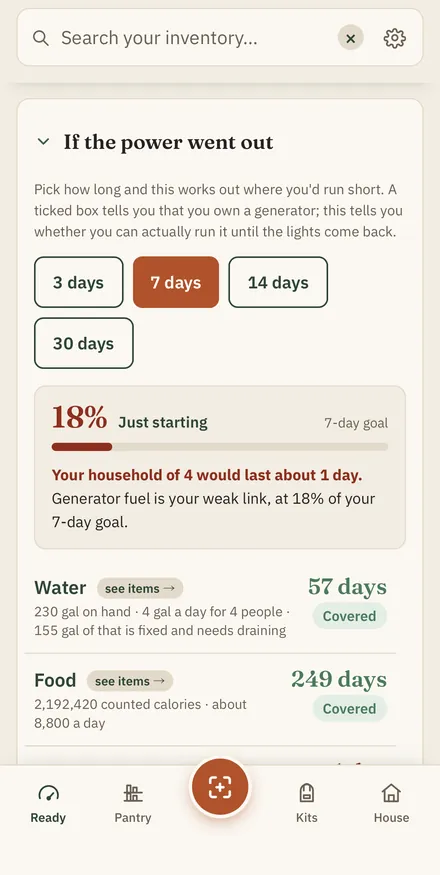
The Days of Supply outage planner showing water covered at 57 days, food covered at 249 days, and an 18 percent readiness score against a 7-day goal.

We never know when it will be our turn

Why I built Days of Supply, and why I use it myself.

Recently our family went five hours without power. Not long after, we were under a tornado warning, here in Utah. Both times I opened the app and knew exactly what we had and how long it would last.

Adding my shelves, I found food I thought was good had already expired. And at the case lot sale, I bought what we were missing instead of guessing.

TroyFounder of Days of Supply, Washington County, Utah
The weakest resource sets the number

Most preparedness advice counts calories and stops. But a year of wheat is worth very little if you run out of the fuel to cook it in a fortnight. This works out every resource separately, then reports the one that fails first.

Try it with a sample family of four. City water, natural gas, a portable generator with 40 gallons of gas, 40 gallons of stored water, about three months of food, and a wood stove. It starts on an earthquake on a hot St. George day.

What kind of emergency?
Temperature outside
95°F
For how long?

Find your weak link Start with one room. The number updates as you go.

Pick the emergency, and see what still works

A power outage and an earthquake are not the same problem. Tell the app once how your place runs, and it works out what keeps going in each one.

  • Six kinds of emergency: power outage, earthquake, winter storm, water shut off, stuck at home, and having to leave.
  • Your generator, well and solar, counted honestly. A natural gas Generac stops when the gas is shut off. A well pump stops with the power. Most rooftop solar shuts off in an outage.
  • Today's temperature counts. On a 105°F day your family needs about twice the water, and below freezing, heat becomes a must. One tap fills in today's weather.
Try your own house
If disaster hit
Power outageEarthquakeWinter storm
Earthquake. Power off, gas off, city water off, stores closed. Right now: 105°F, so water is counted at 2 gallons per person.
Water60 gallons on hand, 8 a day for 4 people
7 days
Standby generatorRuns on the gas line, which is shut off
Gas off
CoolingNo power, so no air conditioning
Danger

Take it to the case lot sale

Stand in the aisle, open the app, and see what you already have and what you're missing. Search any item to see how many you have and when they expire, and the shopping list shows what's below the minimum you set, in the case sizes you actually buy.

  • No doubles. You'll know there are already eighteen cans of peaches in the basement.
  • Nothing missed. What you're short on is right there when the prices are low.
  • Expired food found. Scanning your shelves flags what's past its date, so it gets replaced, not counted.
Build your shopping list
In the aisle
White riceHave 2 #10 cans, minimum 8
Buy 6
Green beansHave 4 cans, minimum 24, cases of 12
2 cases
Refried beans3 of your cans expired in March
Expired
Canned peachesHave 18, good until 2028
Plenty

What you can do with what you've got

Counting is the start. These turn the count into dinner, into a plan for the cabin, and into an honest look at what the animals cost you in water.

Dinner from what's on the shelf

Pick breakfast, lunch, dinner or dessert, and it builds three recipes from your own pantry, starting with whatever is closest to its date. Switch on No power and every recipe works on a camp stove or with no cooking at all.

  • Uses your real shelves, not a shopping list you'd have to go and buy.
  • Rotates your storage by cooking the oldest cans first.
  • Names one thing to pick up when a single ingredient would make it much better.
Try the recipe finder
What can I make?
BreakfastLunchDinnerDessert

Refried bean and rice skillet

About 25 minutes, serves 4
The beans are past their date. Check the cans before opening.
2 cans refried beans1½ cups white ricecumin
One thing to pick up: an onion

Hens, goats and a milk cow count too

Animals are the only part of a food supply that keeps coming. They're also the thirstiest thing on the property. Add them and the app counts both: eggs and milk for as long as the feed lasts, and every gallon they drink.

  • Feed in days, so you know when the eggs stop.
  • What they eat, and what you could share from your own pantry, plus what to keep away from them.
  • Their water is counted, because a cow can drink more in a day than a family of five.
Add your animals
Animals
12 laying hensAbout 8 eggs a day, feed lasts 66 days
1 milk cowAbout 4 gallons of milk a day, drinks 25 gallons of water a day
20
days of water before
2
days with the animals

The cabin gets its own number

A week of food at home tells you nothing about the cabin. Each place keeps its own shelves, its own setup and its own days of supply, and a bar at the top always shows which one you're working on.

  • Home, cabin, RV or land, each with its own power, water, weather and generator.
  • Invite the kids to the cabin, and only the cabin. Tick which places each person can see. They'll know what's there before they leave, and you'll know what they used.
  • One plan covers four on Extended: home, cabin, RV and vacation home.
Add your places
Working onThe cabin
Switch place
Family homeHome
57 days
The cabinCabin or second home
4 days
Travel trailerRV kept away from home
11 days

Fuel that knows what kind it is

Stored fuel goes off, and not at the same rate. Treated gasoline is good for about a year, mixed two-cycle for a couple of months, kerosene for years. Propane cylinders need requalifying twelve years from the stamp on the collar, after which a filling station can legally turn you away.

  • Knows the difference between a bulk tank, a 20-lb cylinder and a 1-lb canister.
  • Tracks the stamp date on every cylinder and warns you a year before requalification is due.
  • Flags a generator with no carbon monoxide detector logged in the house.
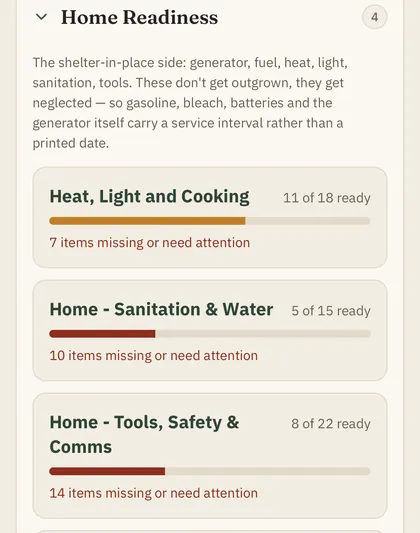
The Home Readiness panel showing progress bars for heat light and cooking, sanitation and water, and tools safety and comms.

Medication counted in days, not bottles

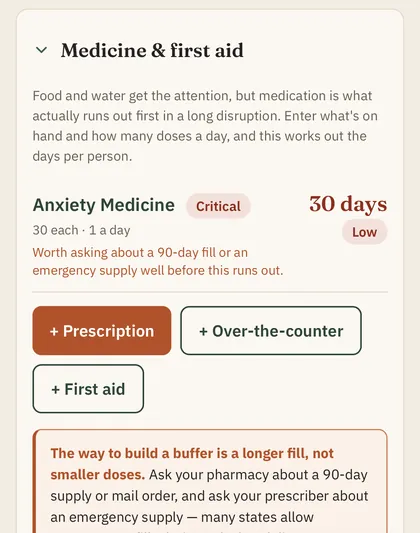
Medication is what actually runs out first in a long disruption, and it's the one thing you can't improvise. Enter what's on hand and how many doses a day, and you get days per person, with critical prescriptions warned earlier because a 90-day fill needs planning.

  • Critical items warn at 60 days, everything else at 30.
  • Suggests the longer fill, never a smaller dose.
The medicine panel showing an anxiety prescription marked critical with 30 days remaining and a low status.

The documents that expire quietly

A rusted can you can see. An expired passport you can't. Pick the document from a list and add its expiration date, and the app warns you early enough to renew: a week ahead for a fishing license, three months for a passport.

  • Pick, don't type: passports, driver's licenses, hunting and fishing licenses, insurance, wills and deeds.
  • Knows what never expires, like a birth certificate, so it doesn't nag you about it.
  • Print a document sheet to keep with the originals in the go-bag.
Licenses & documents 1 needs renewing
PassportExpires March 15, 2031
Valid
Utah fishing licenseExpires in 5 days
Renew now
Driver's licenseExpires June 2, 2027
Valid
Birth certificateKept in the fire safe
Doesn’t expire

Hunting and fishing add days back

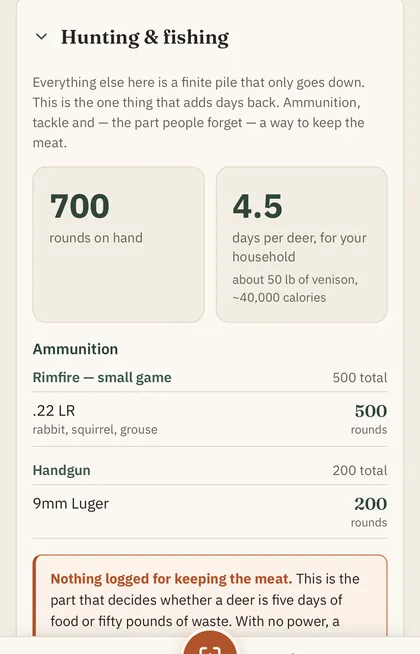
Ammunition and tackle are counted alongside the part people forget: a way to keep the meat, which decides whether a deer is five days of food or fifty pounds of waste.

  • Roughly 50 lb of venison works out as days of food for your household size.
  • Warns when nothing is logged for preserving it without power.
The hunting and fishing panel showing 700 rounds on hand and 4.5 days of food per deer for this household.

Easy enough for the whole family

Grandparents use this. So every button says what it does, and nobody has to hunt for anything.

  • A setup guide walks you through it, one step at a time, and checks each one off as you go.
  • Red means unfinished, green means complete, so you can see at a glance what still needs you.
  • Search finds features, not just food. Type "generator" or "print" and it takes you straight there.
  • Help in plain words, and a Suggest button that goes to a real person.
Let's get you set up
✓Your household
✓How your home runs
3Generator and fuelAnswer
4Your stored water
5Scan 3 food items

Getting it all in there is the hard part

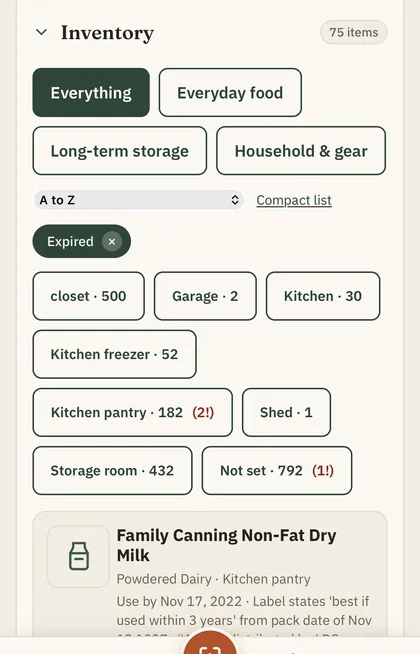
So point your phone at the label. It reads the product, the date, the calories and the category, and files it, including the pack dates and "best if used within three years" wording on a case of storage food.

  • Sorts by where it lives: kitchen pantry, storage room, shed, freezer, closet. Count one room at a time.
  • Separates everyday food from long-term storage, because a fortnight of pasta and a decade of wheat are not the same shelf.
  • Import a spreadsheet if you already keep one, and export back whenever you want.
  • Works offline. The storage room is usually where the signal isn't.
Scan your first label
The inventory screen with filters for everyday food, long-term storage and household gear, and counts by storage location.

Pick the target you're actually working towards

Set the goal and the app works backwards to what's missing, in the units you'd buy it in.

A year's supply

The long-term staples counted the way they're normally taught: grains, legumes, milk, fat, sugar and salt, per person, with what's still short expressed in buckets and cases rather than pounds.

Two weeks at home

The FEMA baseline: a gallon of water per person per day and food that needs no cooking, checked against what a shelter-in-place order would actually demand of your house.

Start free. Pay when it's earned its place.

Every account starts with 7 days of everything and no card. After that, stay on the free plan or subscribe. Either way the inventory is yours, and you can export it to a spreadsheet whenever you want.

Every plan counts your whole family, however big it is. The limits below are only how many people can sign in and help keep it up to date, and on Extended that's everyone.

Free

Where you land after the 7 days if you don't subscribe.

$0
No card needed
  • Unlimited items, entered by hand
  • Expiry dates and shelf-life tracking
  • Shopping list with minimums and case sizes
  • Animals: eggs, milk, feed and water
  • 10 label scans a month
  • 3 recipe ideas a month
  • One sign-in, one property
Start free

Extended

For the cabin, the RV, the vacation home, or parents you keep stocked.

$99.99
a year
  • Everything in Household
  • Up to 4 places: your home, a cabin, an RV and a vacation home, each with its own number
  • Choose which places each person can see
  • Unlimited family members can sign in and help, however big your family is
  • Vehicle kits for each car
Start 7 days free

Need something bigger?

Family compounds, ranches with several homes, preparedness groups and businesses can get a custom plan. Tell us what you need and we'll put together a plan that fits.

Ask about a custom plan

Cancel any time from inside the app. Nothing is deleted when you do: you keep your inventory and lose only the paid features.

Give it to the people you look after

Grandparents give it to their grown kids' families. Businesses, agents and groups give it to their clients, members or employees. The more families, the lower the price for each.

A year for each family
FamiliesHouseholdExtended
5 to 9, a family gift$50$85
10 to 49$45$75
50 to 249$35$60
250 to 999$30$50
1,000 or moreLet's talk

Regular prices are $59.99 and $99.99 a year. Gifts for 2 to 4 families are at the regular price, and savings start at 5. Paid once, up front.

A gift that gets used

Grandparents give it to each of their kids' families for Christmas. Real estate agents give it to buyers at closing, and to past clients as a thank-you. It keeps you in their thoughts all year, every time they open the app.

How it works

  1. Pick your own code, like SMITHFAMILY or STGEORGE4TH, and how many families.
  2. Pay once, and print a flyer and gift cards with your name and code.
  3. Each family signs in and enters the code. You see how many have joined, never what's in anyone's list.

Questions

Do I have to enter everything before it's useful?

No. Start with one room. The number updates as you go, and a partial count still tells you which resource is weakest, which is usually the useful part.

What kinds of emergency does it plan for?

Six: a power outage, an earthquake, a winter storm, the water being shut off, being stuck at home with no stores, and having to leave. Each one assumes different things still work, using what you've told the app about your power, water, gas, generator and the weather.

I'm not good with phones. Is it hard to use?

It's built for people who don't want to fiddle. A setup guide walks you through each step, the buttons are big and say what they do, and the search box finds features as well as food. If you get stuck, tap Help, or tap Suggest and a person will write back.

Will it tell me what's expired?

Yes. Every item with a date shows whether it's good, due soon or past its date, and the list of what to use first is always on the Pantry tab. Many people find food they thought was fine the first day they scan their shelves.

Do I need a card to try it?

No. Every account gets 7 days of everything without a card. If you want to keep the paid features after that, you pick a plan then.

Where do the recipe ideas come from?

From your own shelves. The app reads what's in your pantry, favours whatever is closest to its date, and suggests meals that use it. Anything past its date gets a clear reminder to check it first, and past-date dairy, meat and eggs are never used.

How does it count animals?

Eggs and milk add food for as long as the feed you've stored lasts, and meat animals count once. Their water is added to your household's daily use. The figures are typical starting points you can change to match your own animals; your vet or the USU Extension office can tell you what yours need.

Is there a limit on family size?

No. Every plan plans for everyone in your household, whether that's two people or fourteen, pets included. The only difference is how many of you can sign in and help: one on Free, three on Household, and everyone in the family on Extended.

Why a separate place for a cabin or RV?

Because days of supply is arithmetic about one building. A week of food at home tells you nothing about the cabin, so each place keeps its own inventory and its own number, and you choose who in the family can see each one.

Is my inventory private?

Your account is yours alone, and the only people who can see it are the ones you invite into your household. Sign-in is a link sent to your email, so there's no password for anyone to steal.

Does it work on a phone?

It's built for one. Add it to your home screen and it runs like an app, including offline in the storage room where the signal drops.

Know before you need to

The next outage or warning won't wait for you to count. Most families are surprised, usually not by the food, but by the thing next to it that runs out in a day, or the cans that expired years ago.

7 days of everything, free. No card to start.